Nobel Symposium 210 · Stellenbosch · 26 October 2026

Algorithms as Collisions

Selected slides from the talk by Elham Kashefi, to recall the goal, the Atlas, the engine, and what we do with data from hardware. Select a slide to open it full size.

The goal

Four questions, and the method
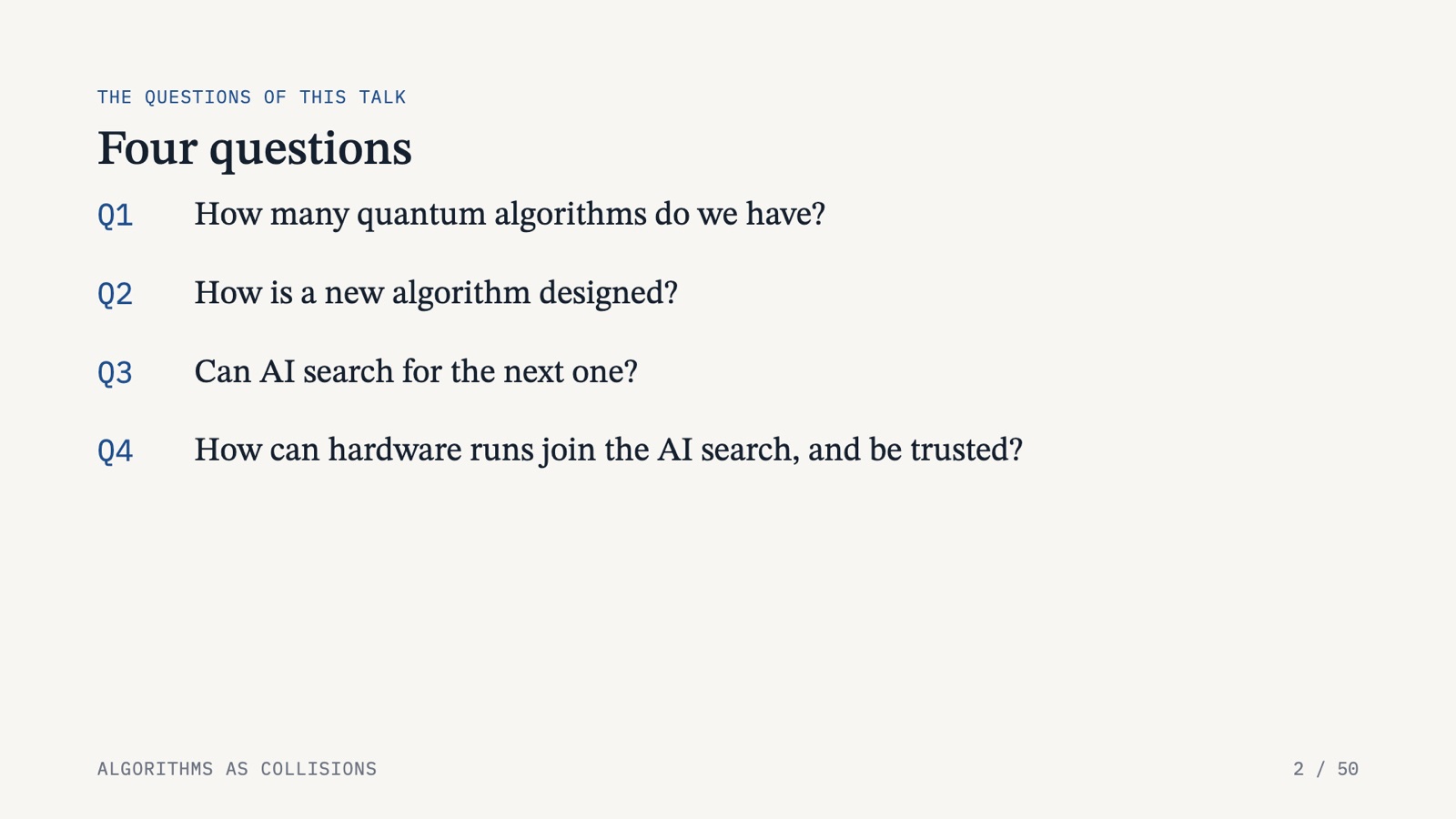
Slide 2, Four questions: how many quantum algorithms do we have; how is a new algorithm designed; can AI search for the next one; how can hardware runs join the AI search, and be trusted.
Four questions.The talk answers them in order: the inventory, how algorithms are designed, an AI engine that searches for new ones, and how hardware runs can join that search and be trusted.
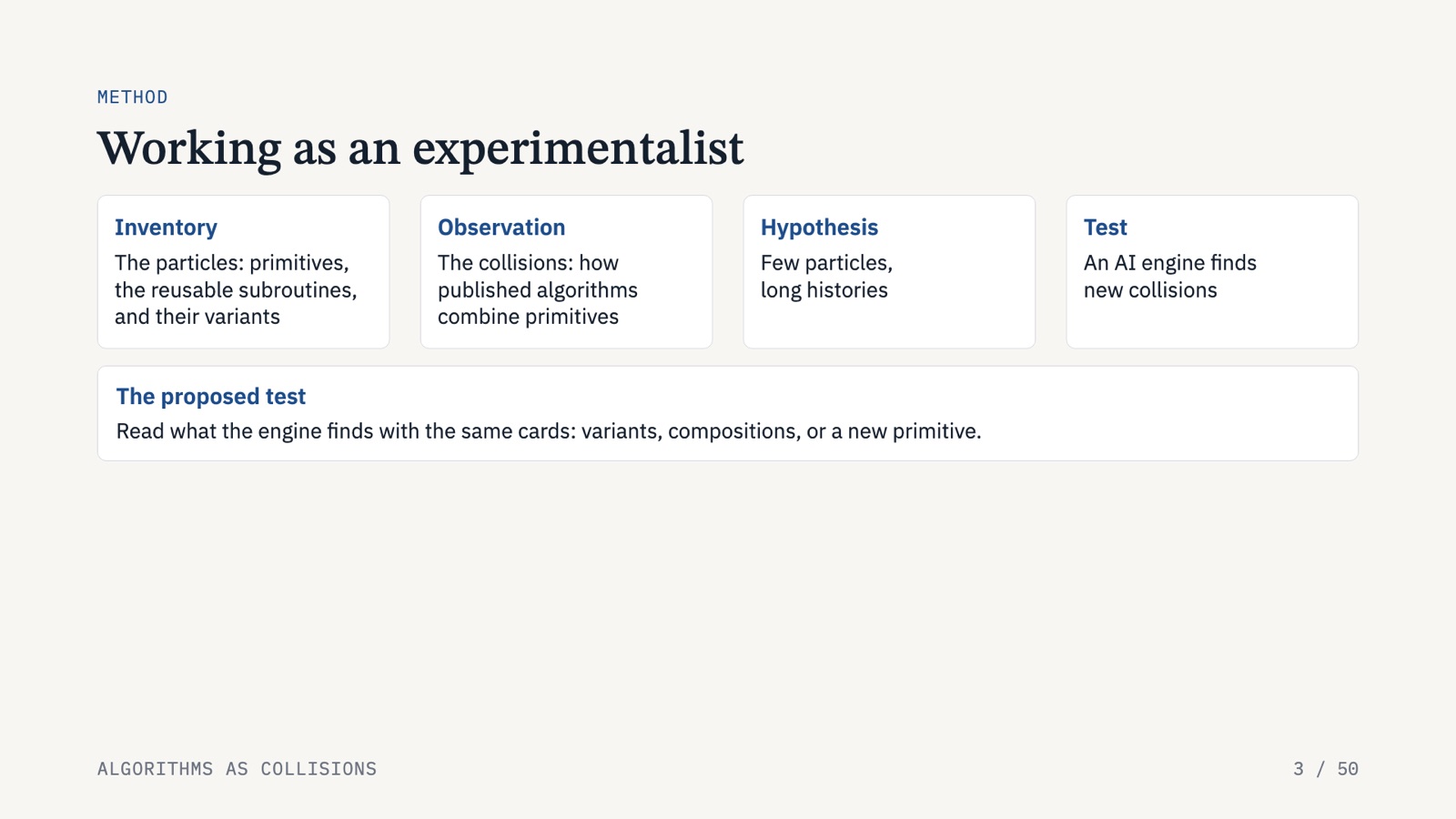
Slide 3, Working as an experimentalist: inventory of the particles, observation of the collisions, a hypothesis, and a test by an AI engine.
Working as an experimentalist.The primitives are the particles; an algorithm is what we see when a few of them collide. Inventory, observation, hypothesis, and a test: an AI engine finds new collisions, read with the same cards.

Q1 · The contract

A primitive is identified by its contract
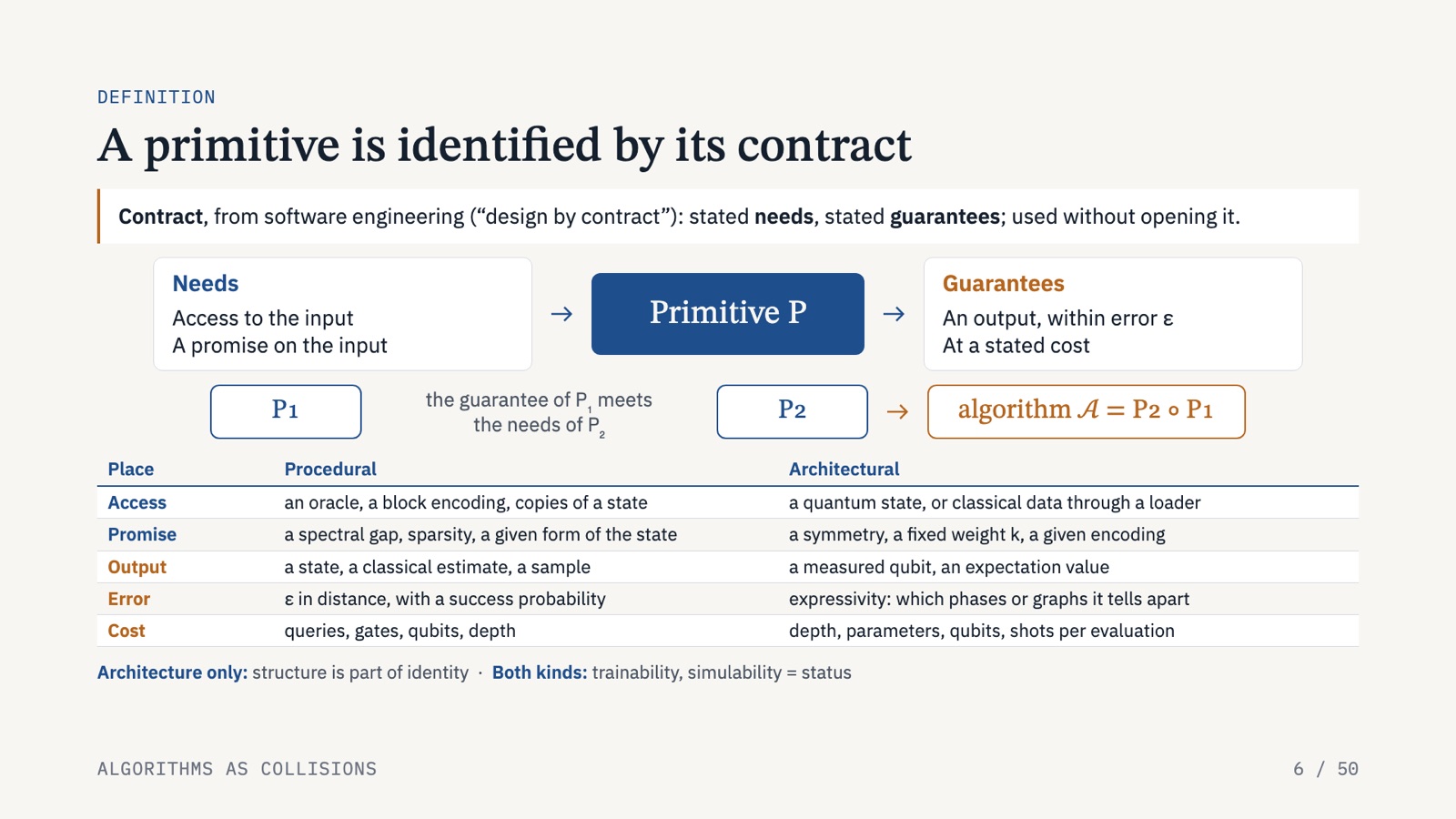
Slide 6: needs (access, promise) and guarantees (output, error, cost); composition when the guarantee of one meets the needs of the next; a table of the five places for procedural and architectural primitives.
Five places, the same for every primitive.Needs: access and promise. Guarantees: output, error and cost. Two primitives compose when the guarantee of one meets the needs of the next. For an architecture, expressivity takes the place of error.
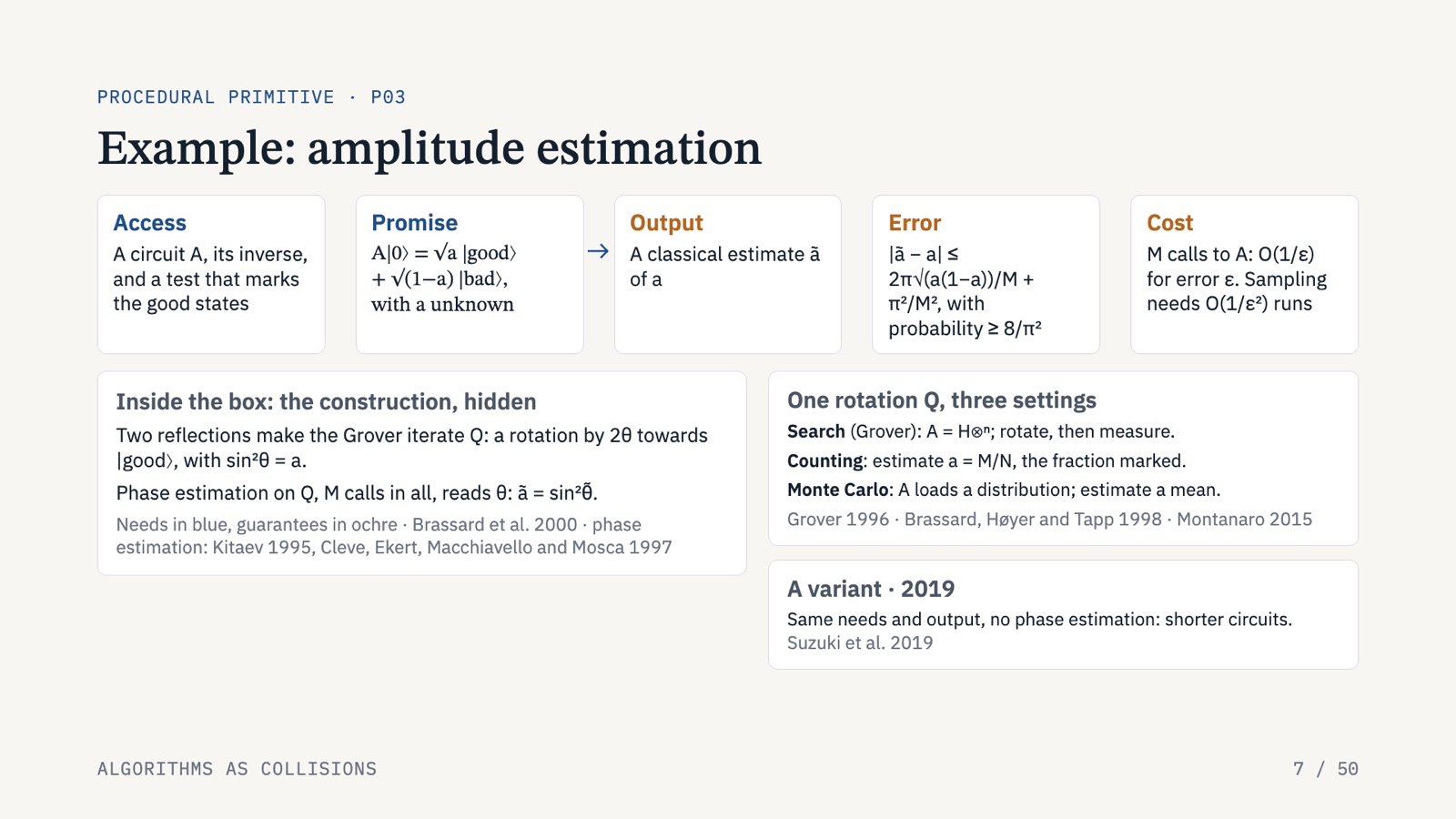
Slide 7: amplitude estimation as a contract, with the construction inside the box and a 2019 variant.
A procedural example: amplitude estimation.The construction inside the box is hidden. A variant keeps the needs and the output, and changes the construction.
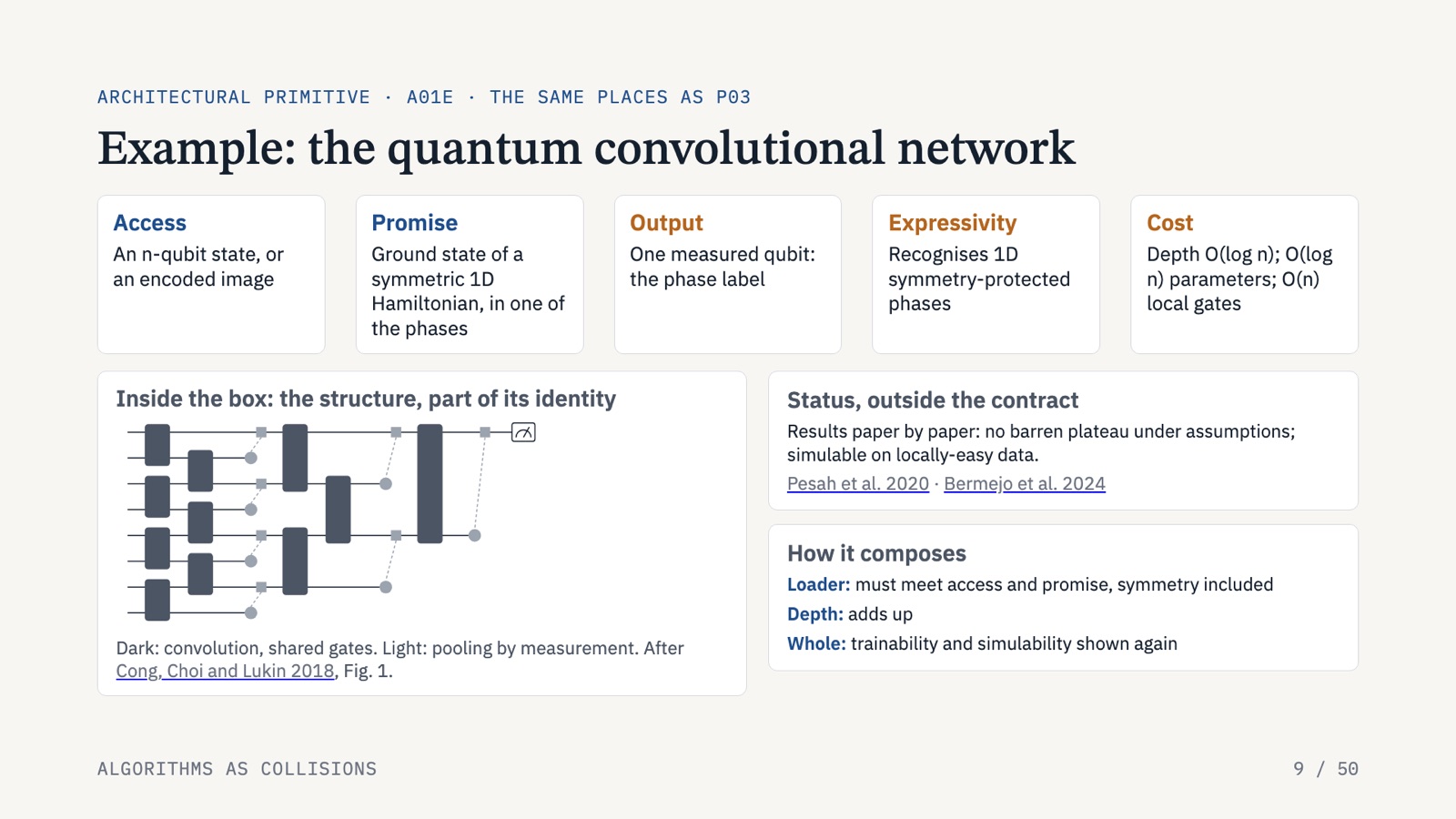
Slide 9: the quantum convolutional network as a contract, with its circuit structure and status.
An architectural example: the quantum convolutional network.The same five places. Here the structure is part of the identity, and trainability and simulability are status, outside the contract.

Q1 and Q2 · The Atlas and the record

42 primitives, and how papers combine them
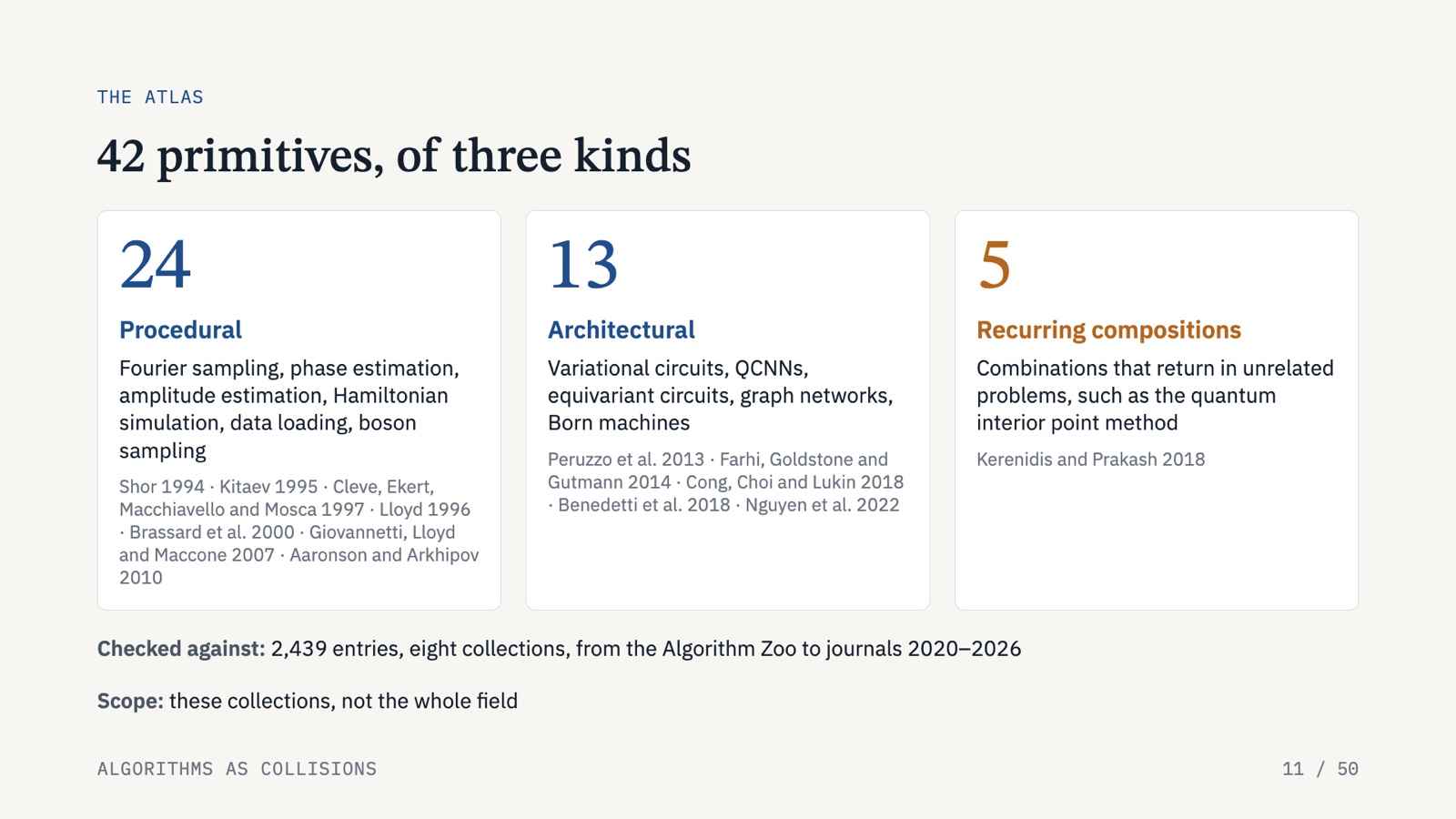
Slide 11: 42 primitives, 24 procedural, 13 architectural and 5 recurring compositions, checked against 2,439 entries from eight collections.
The Atlas: 42 primitives, of three kinds.Checked against 2,439 entries from eight collections. Open the Atlas to read every card.
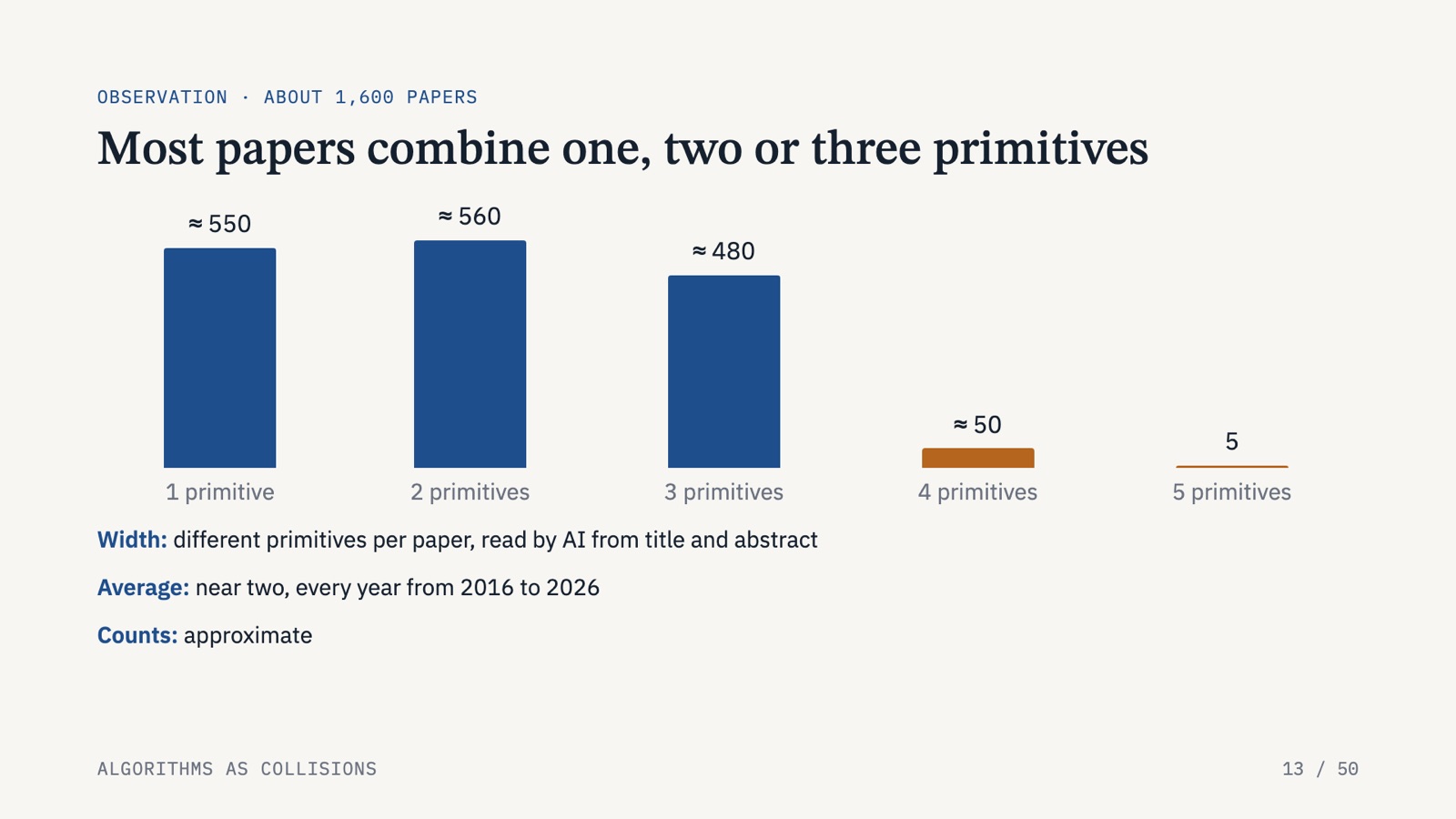
Slide 13: bar chart; most of about 1,600 papers combine one, two or three primitives; the average is near two every year.
Most papers combine one, two or three primitives.About 1,600 papers, labelled from title and abstract; the counts are approximate.
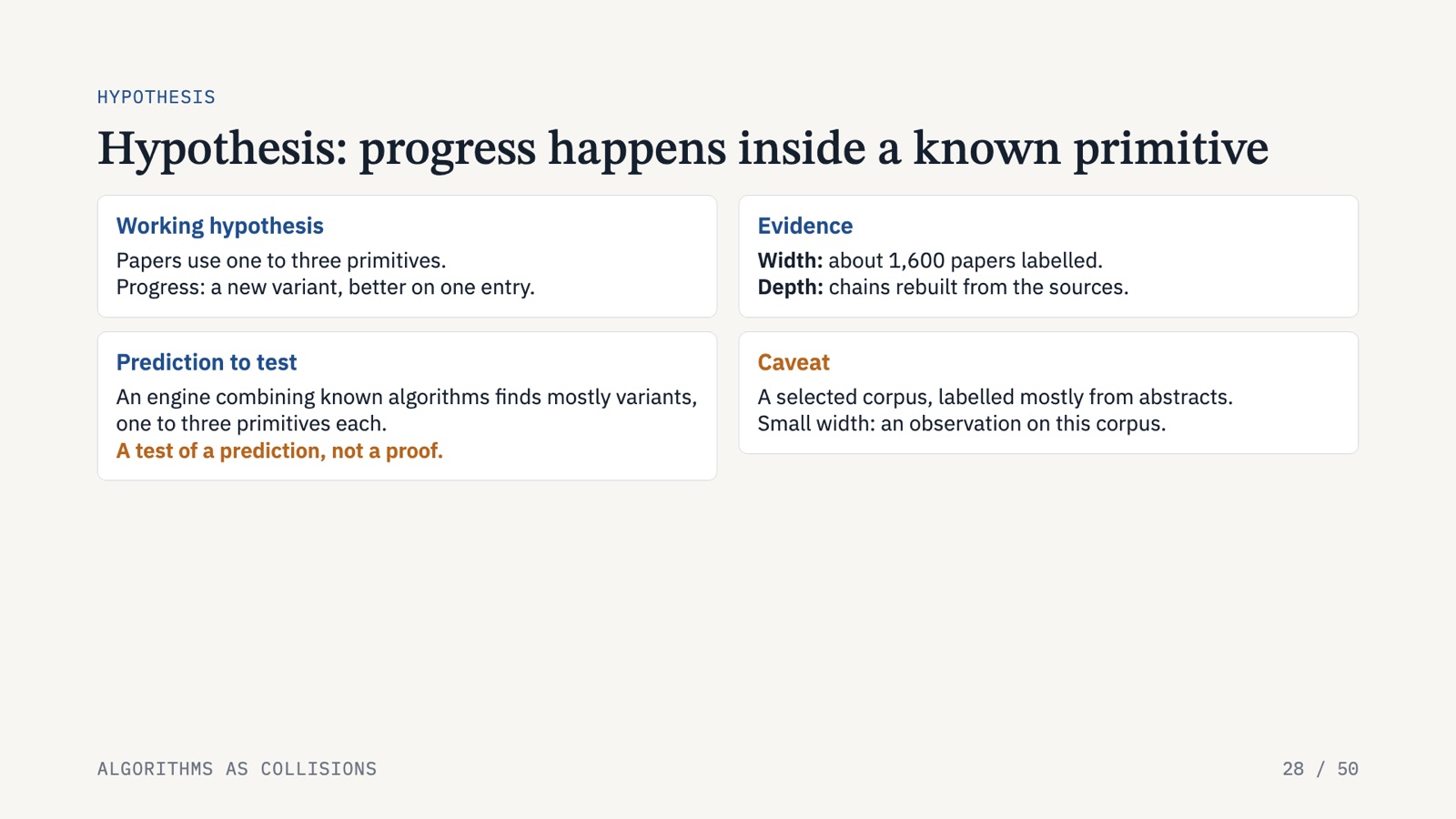
Slide 28: the hypothesis that progress happens inside a known primitive, the prediction to test, the evidence and the caveat.
The hypothesis.Progress happens inside a known primitive: a new variant, better on one entry of its contract. The prediction: an engine that combines known algorithms finds mostly variants.
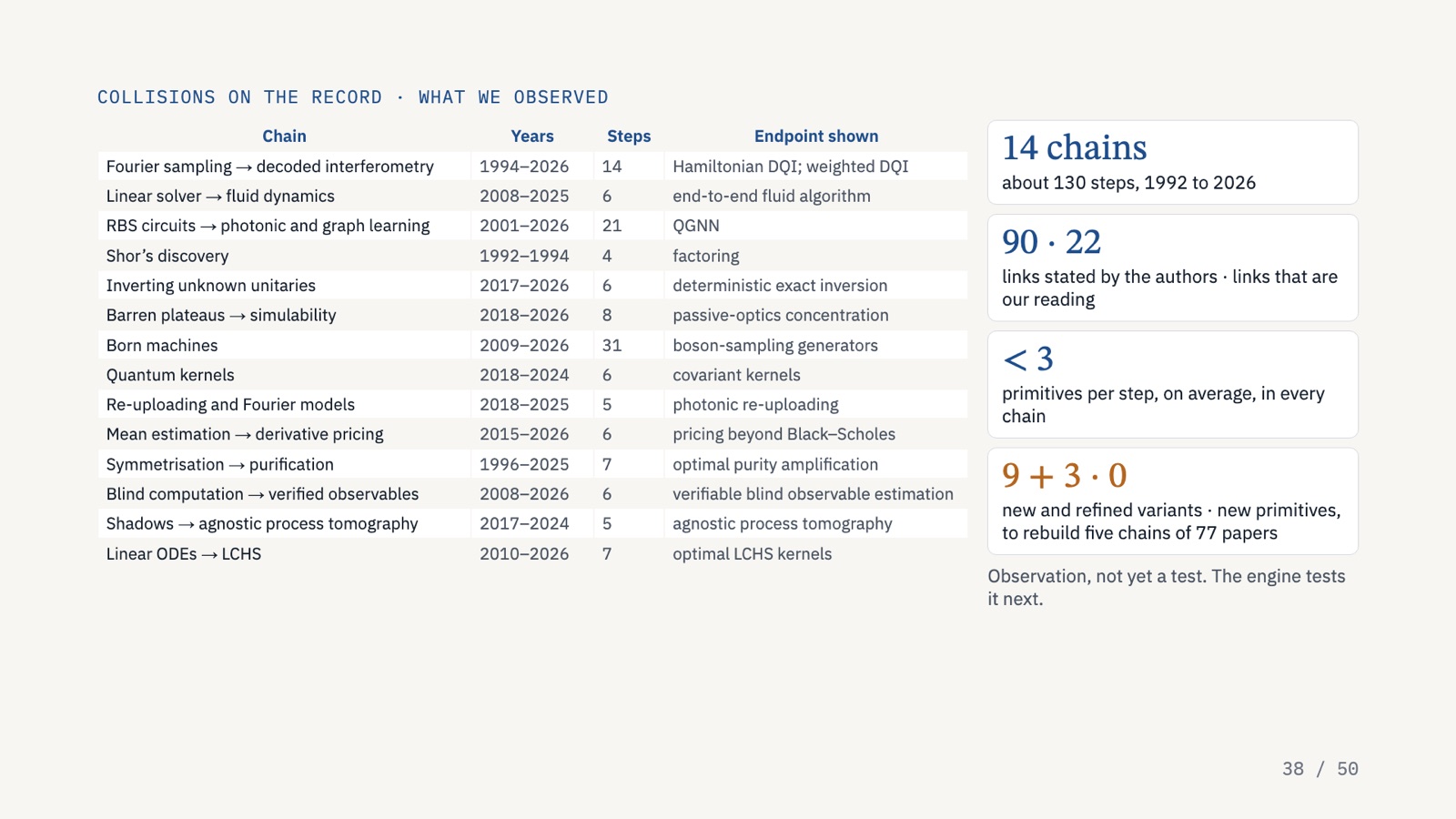
Slide 38: fourteen chains of results rebuilt from the sources, about 130 steps from 1992 to 2026.
Collisions on the record.Fourteen chains rebuilt from the sources: fewer than three primitives per step, and no new primitive in the five chains reviewed closely.

Q3 · The engine

Pathfinder: from the past arXiv to the future one
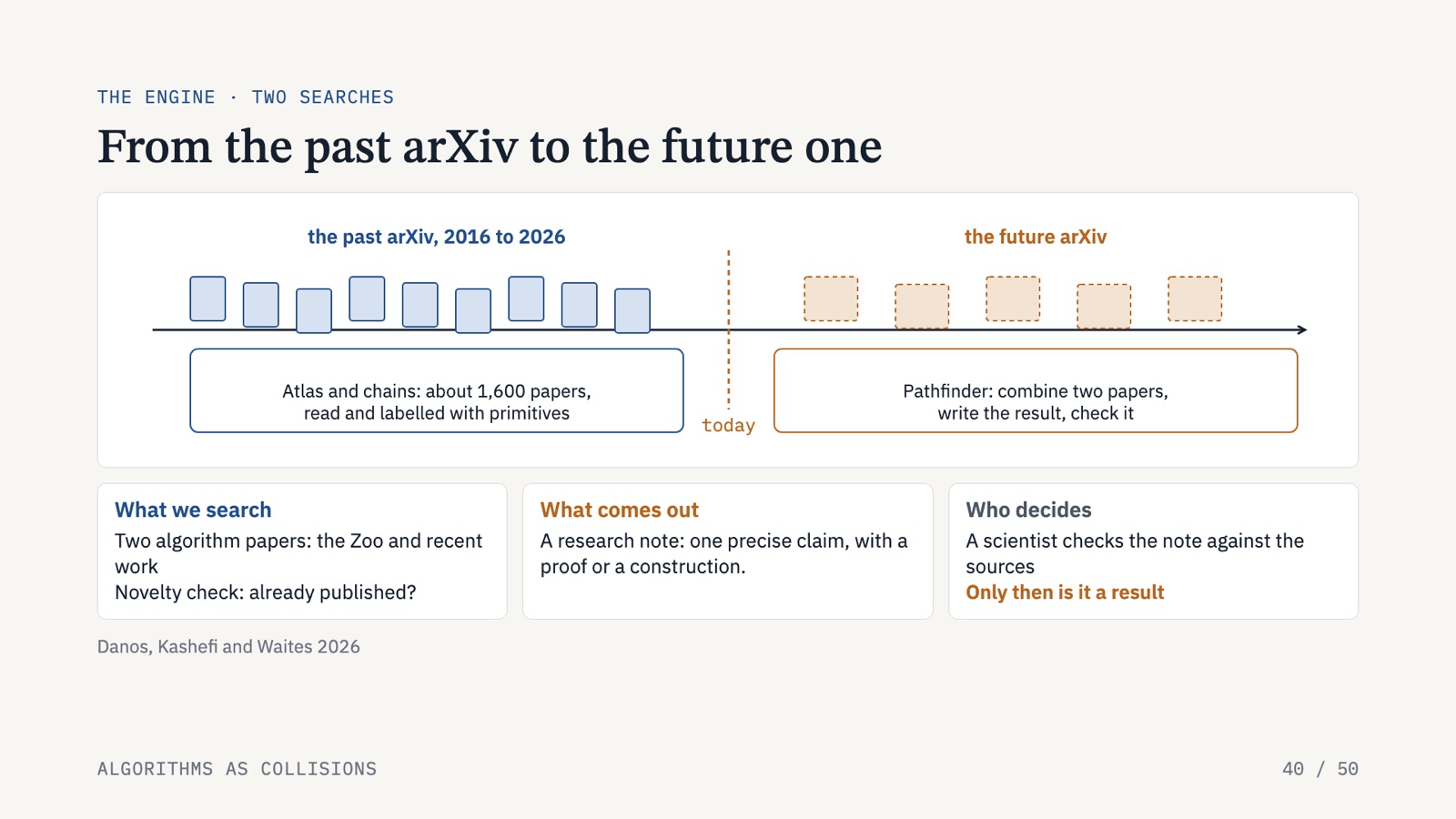
Slide 40: the engine combines two algorithm papers and writes a research note; a scientist checks it.
Two searches.The engine combines two algorithm papers and writes a research note with one precise claim. Only after a scientist checks it against the sources is it a result.
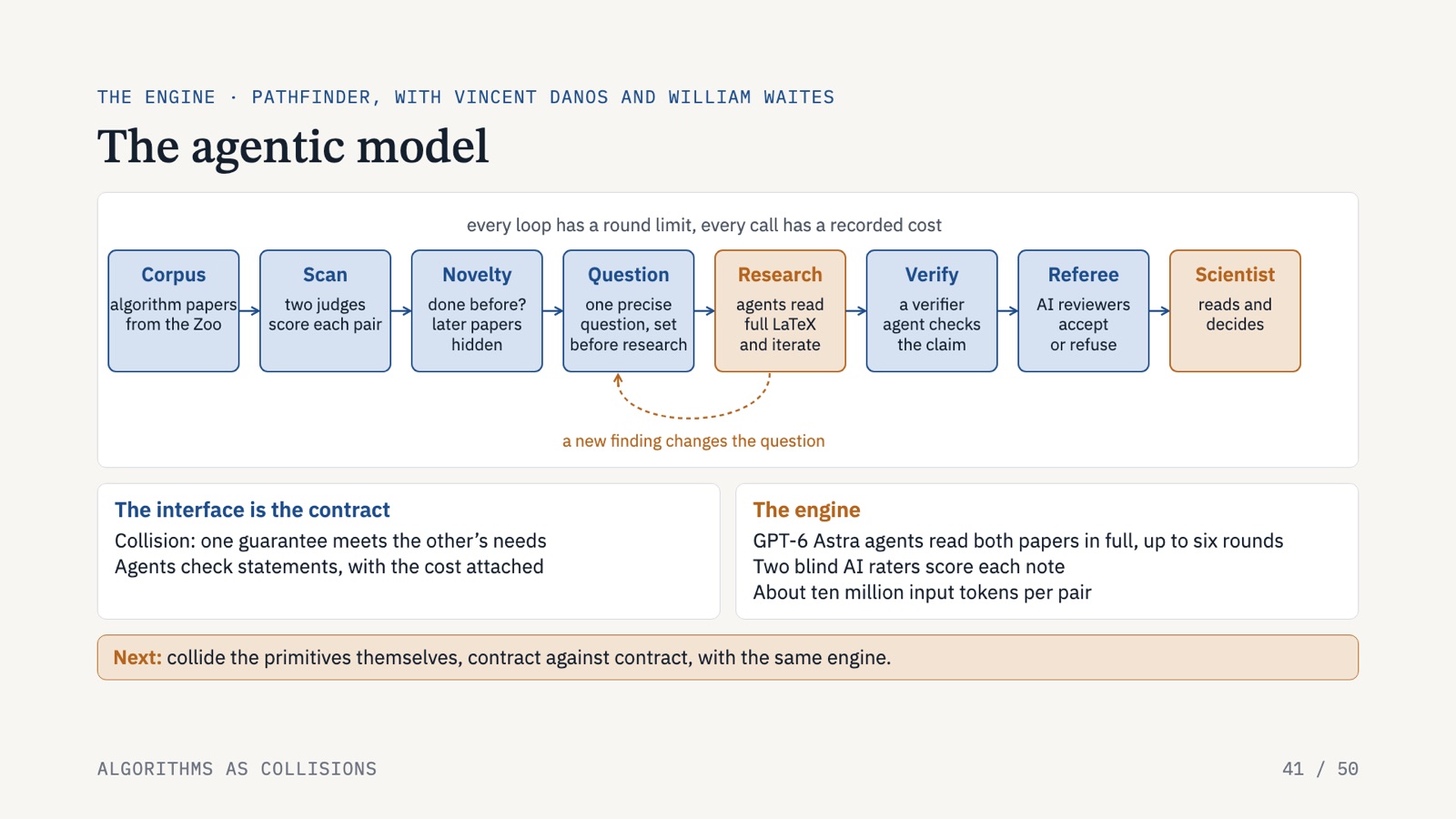
Slide 41: the agentic model, from corpus and scan to novelty check, question, research, verification, AI referees and the scientist.
How the engine works.Where two papers meet is exactly the contract. The next step is to collide the primitives themselves, contract against contract.
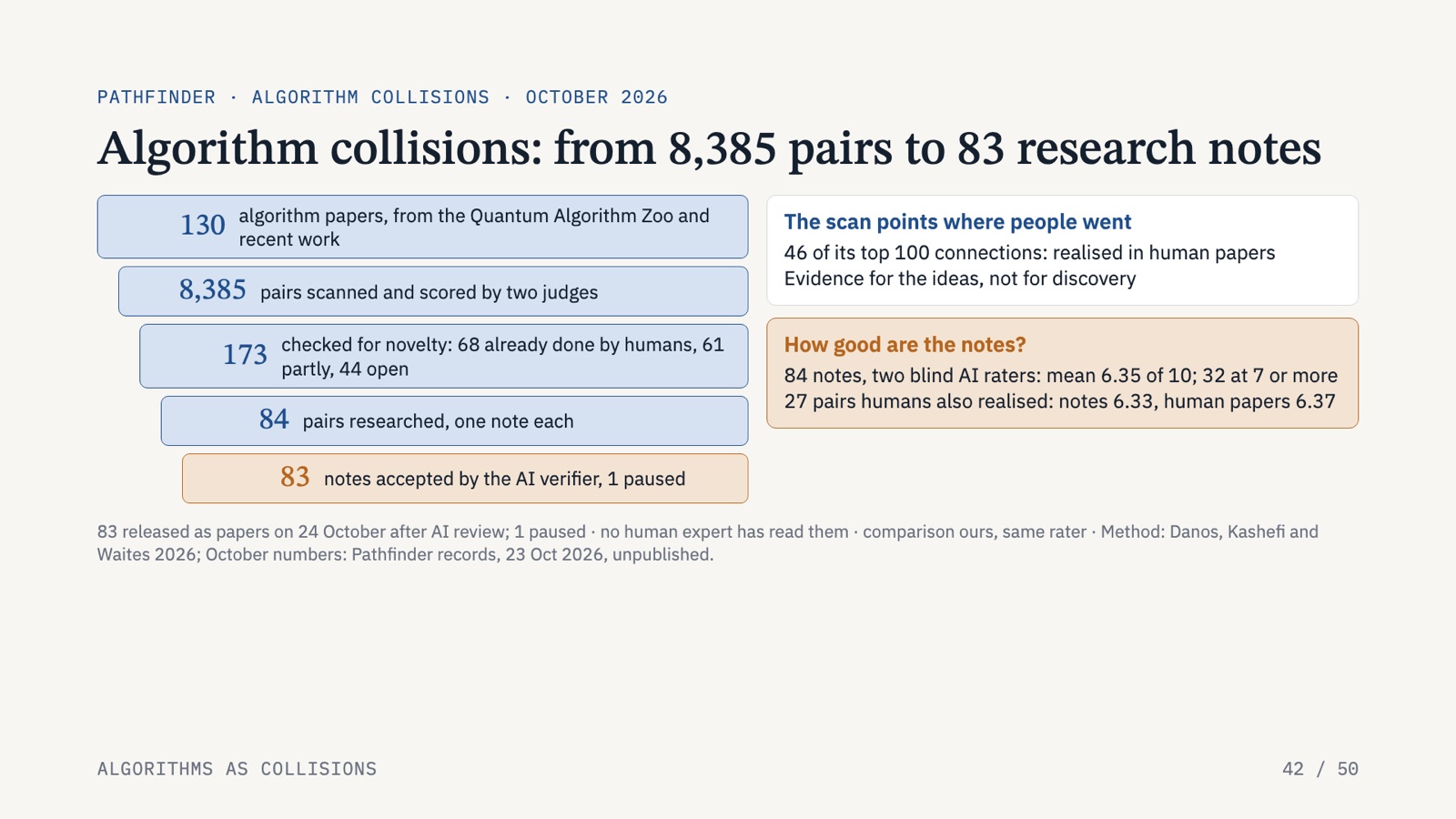
Slide 42: from 8,385 pairs to 83 research notes, with the novelty checks and the blind AI ratings.
From 8,385 pairs to 83 research notes.Rated blind by AI; no human expert has yet read them.
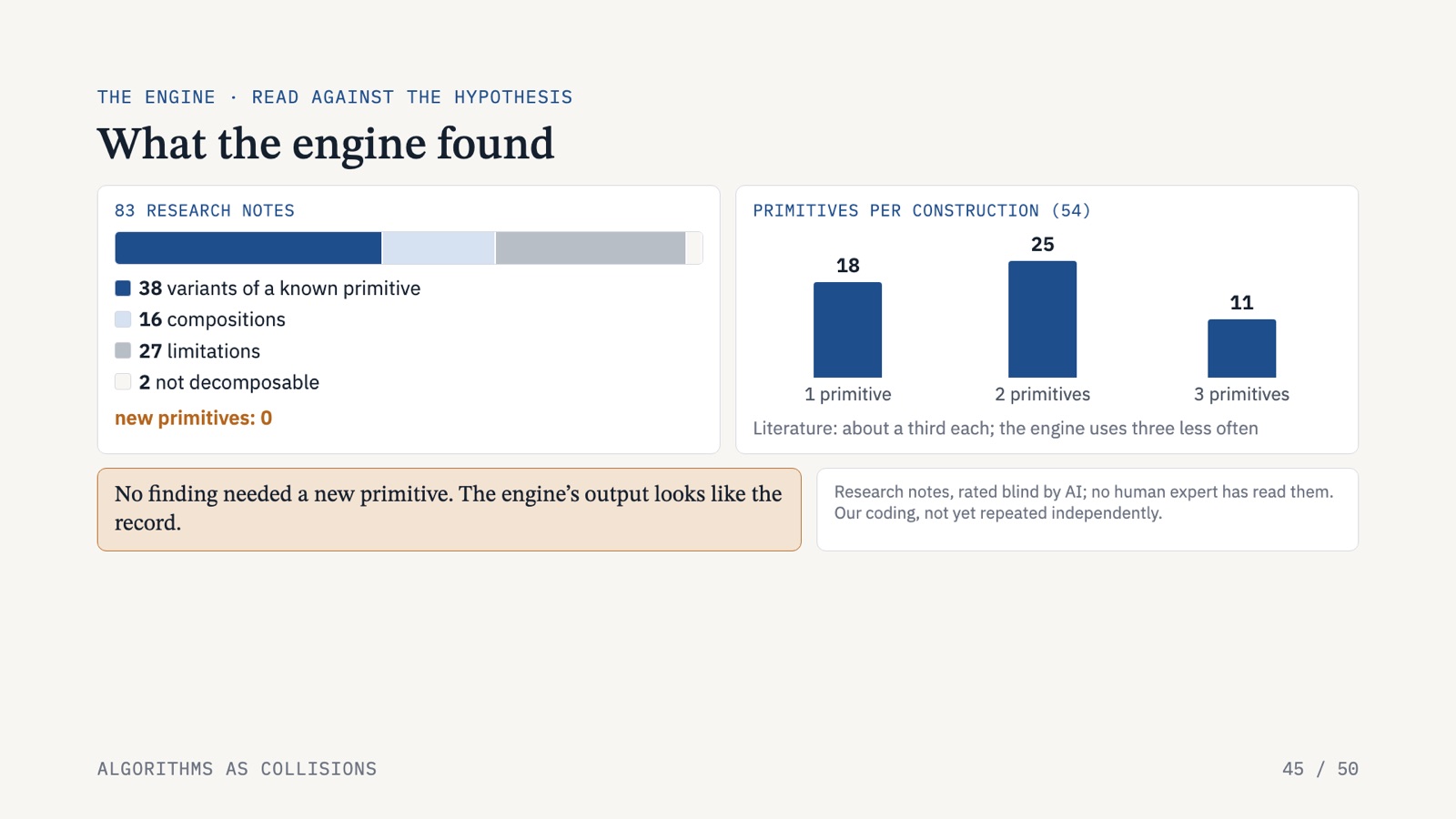
Slide 45: the 83 notes read with the cards: 38 variants, 16 compositions, 27 limitations, 2 not decomposable, no new primitive.
What the engine found, read with the cards.38 variants, 16 compositions, 27 limitations and no new primitive. The engine's output looks like the record. Our coding, not yet repeated independently.

Q4 · Hardware and the loop

A device turns a stated contract into a measured one
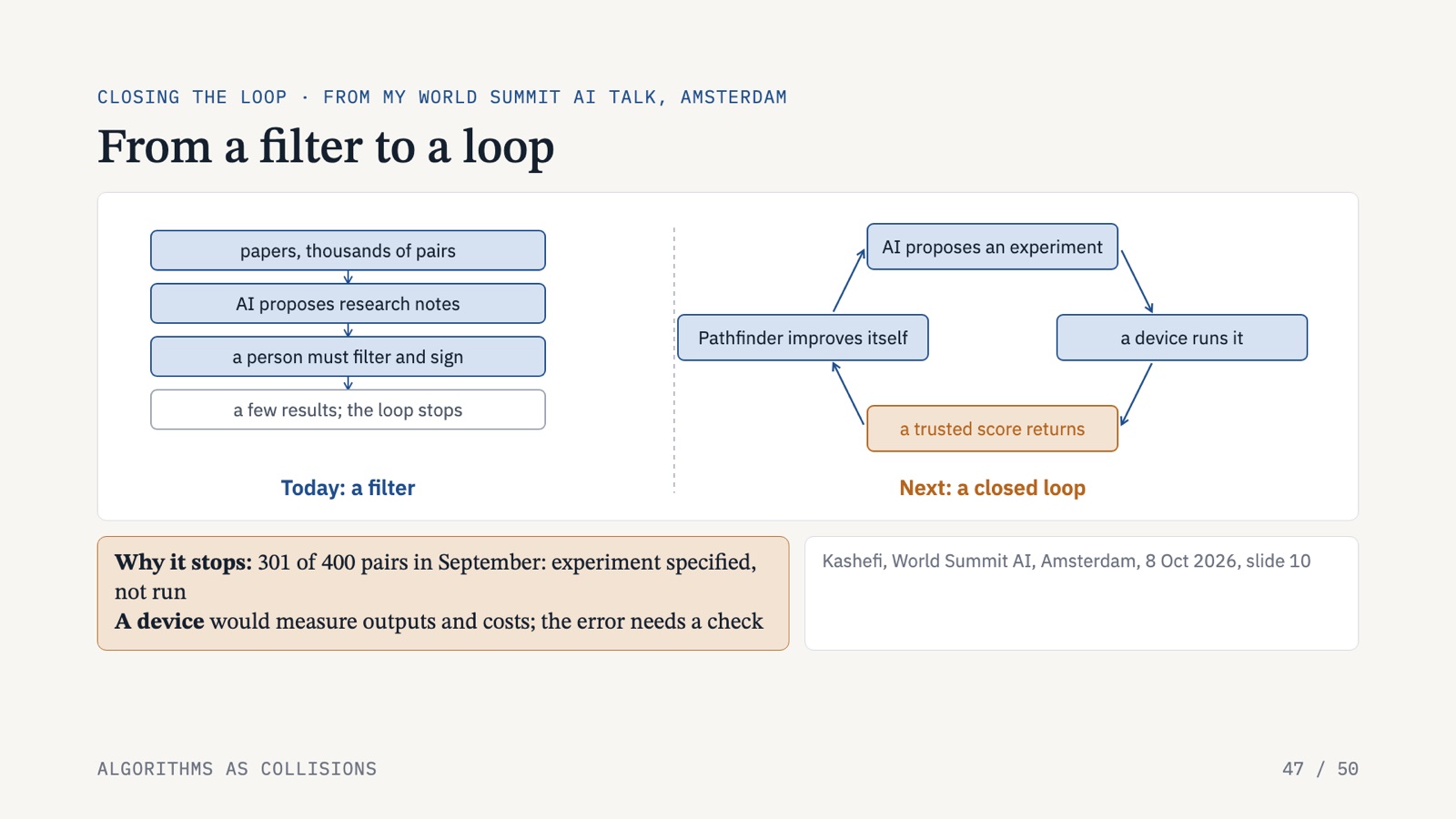
Slide 47: today a filter, next a closed loop where AI proposes an experiment, a device runs it and a trusted score returns.
From a filter to a loop.Next: AI proposes an experiment, a device runs it, a trusted score returns, and the engine improves. A device measures outputs and costs; the error needs a check.
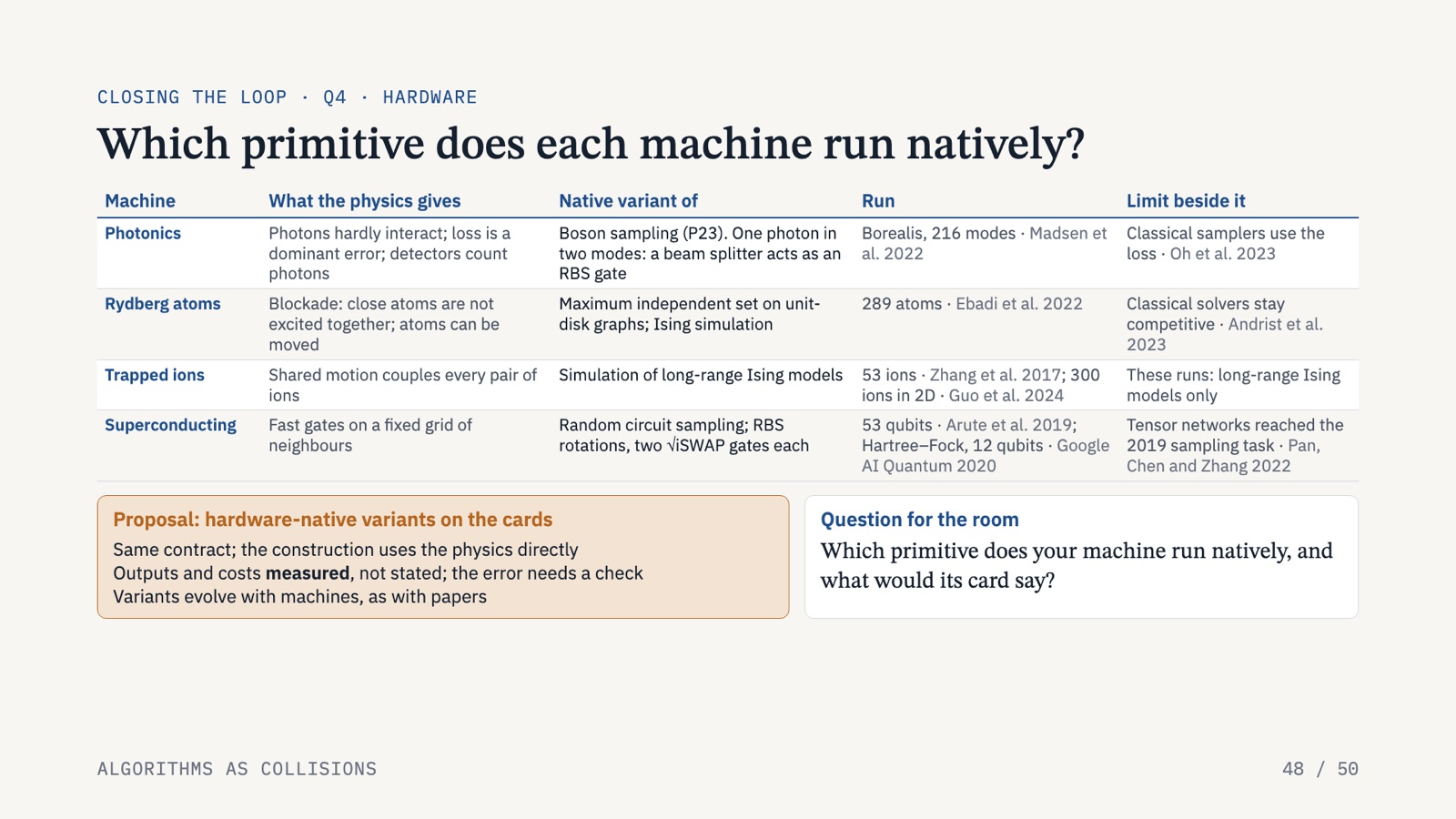
Slide 48: which primitive does each machine run natively, for photonics, Rydberg atoms, trapped ions and superconducting qubits, with the proposal of hardware-native variants on the cards.
Which primitive does each machine run natively?Variants evolve on machines as they do on paper. This is the question behind Primitive–Platform Matchmaking.
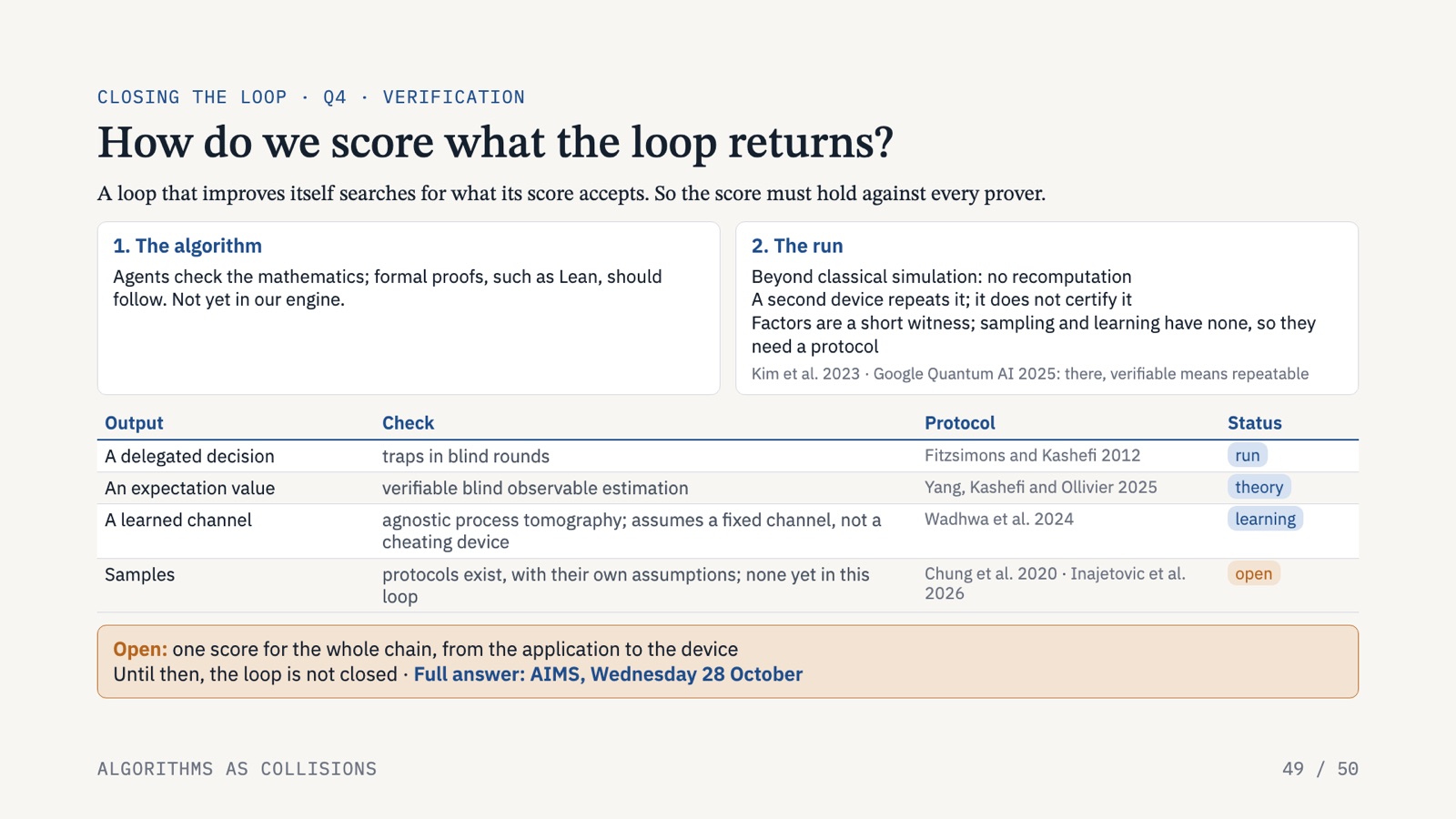
Slide 49: how to score what the loop returns, for the algorithm and for the run; the output type decides the check.
How do we score what the loop returns?The mathematics is checked by agents and, later, by formal proofs. For the run, the output type decides the check. For samples, protocols exist with their own assumptions, but none is yet in this loop.

Where it stands

Where algorithm design stands
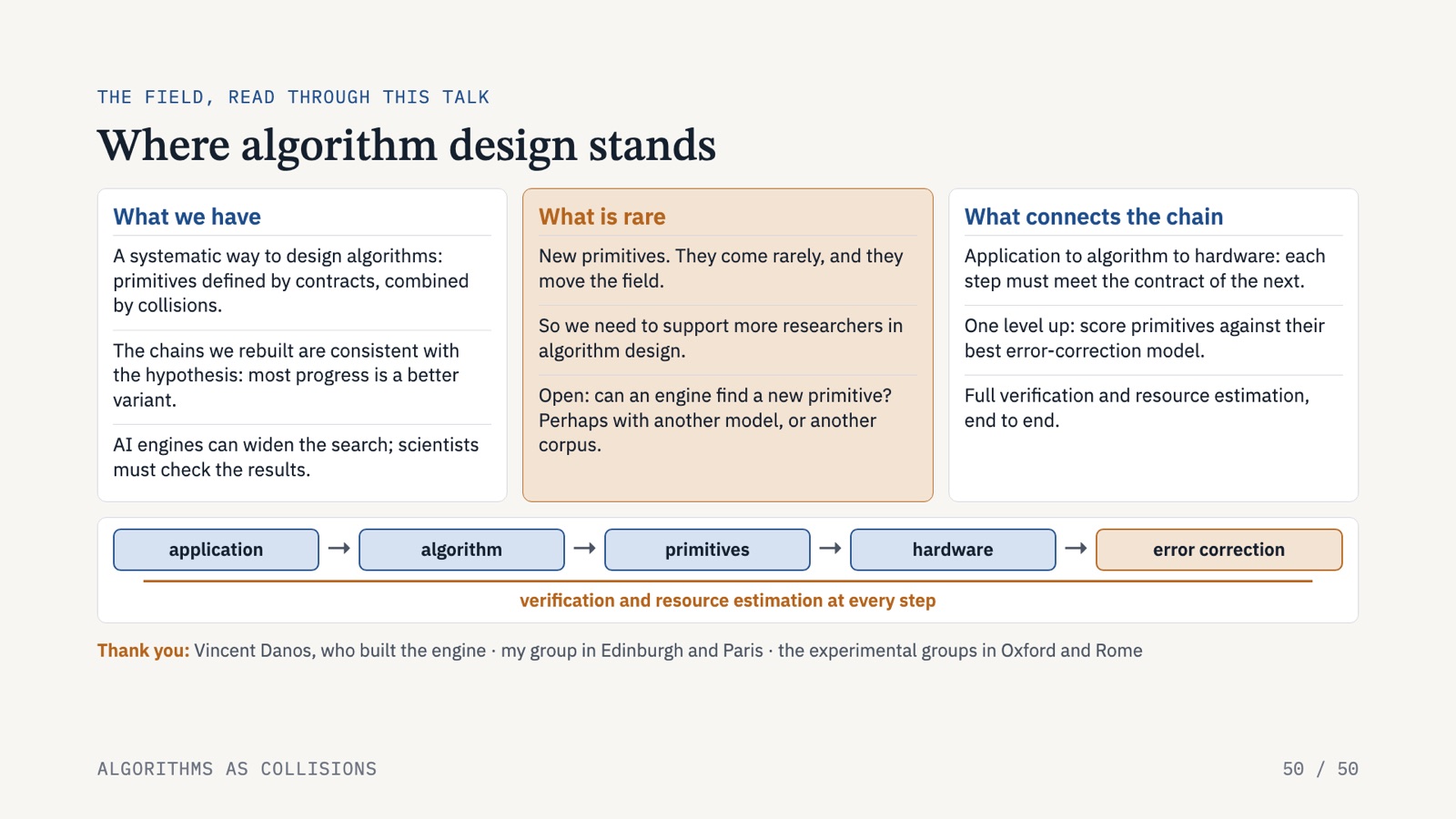
Slide 50: what we have, what is rare, and what connects the chain from application to algorithm, primitives, hardware and error correction.
What we have, what is rare, what connects the chain.Each step, from application to algorithm to hardware, must meet the contract of the next. In the talk, the question for the discussion was: which composition should we test next, and on which machine?